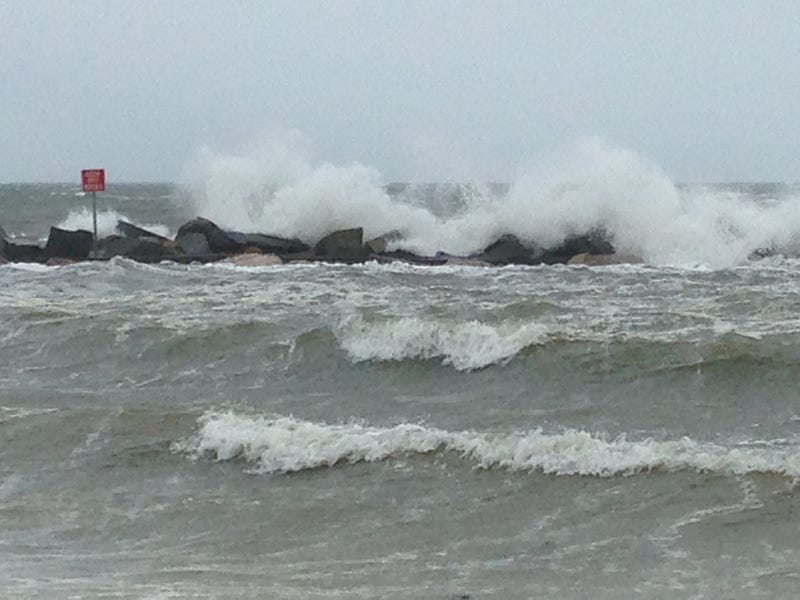
The seasons are changing. It gets dark early up here on the New England coast. I walked down to the beach and there was a stiff wind blowing across the dunes, chopping up the water. I had not checked the tide clock before I left the house so I couldn’t tell if the tide was going out or coming in. It goes out a few hundred yards on this beach, so the difference is dramatic. I could have reached into my pocket and looked at the tide app on my phone but I decided to use my primitive human senses and watch the water. As I stood near the water I could tell after the third wave came rushing towards me that the tide was coming in quickly.
I can’t stop the tides, no one can. People can build a dike, a dam or levy, and hold the water back, direct it or control it. Those measures can work for a while.. The tides are constant and will keep coming, long past my lifetime. They may keep rolling in for a few billion years until the sun explodes. But unlike the tides our human societies are now in constant change, mostly due to new technologies, and despite the current chaos, and the efforts to hold on to old ways, no one can stop those changes from coming either. As Kevin Kelly said, it’s Inevitable.
There is a battle going on to direct the tide of new technologies that are engulfing us and the winner has not yet been determined. It is a confusing struggle as it is difficult to tell who is on which side. Sometimes the innovators and developers are really on both sides at once. On one end there are the applications of technology that can bring progress toward the goal of making people’s lives healthier, happier, more prosperous and creative. At the other end there seem to be many new developments which are being used to manipulate and/ or exploit people. The determination of what will be considered beneficial has become more a question of philosophy than technology or computer science.
The New York Times, a source that I consider reliable, ran an article on November 20, 2016, about a company called Cambridge Analytics, which was based in Cambridge, UK, and funded by Robert Mercer, a hedge fund billionaire who supports many conservative causes and candidates. This company was hired by the Trump campaign.
What the company does, and I would guess that there are similar companies which work on the liberal end of the spectrum, so this isn’t a political rant, gathered data on people’s personality traits, mostly through on-line sites such as Facebook. They offered people the chance to take a personality test, a test designed by my profession (Psychology) to determine the degree to which someone possesses the personality traits of Openness, Conscientiousness,,Extraversion, Agreeableness and Neuroticism (OCEAN). The person got to see how they scored on all of these, and so did the company. Facebook also gave the company access to the names and profiles of each individual. It is easy to understand how that knowledge can be used to design specific ways to approach an individual to sell them something, even an ideology. It could help determine what kind of information this person would find persuasive and how it should be presented.
I am older than most Facebook users, in fact right now I don’t even have a Facebook account and my LinkedIn profile needs to be updated. My training as a Psychologist placed a strong emphasis on trust and confidentiality. It was strongly believed that people who came for therapy would be much more open and revealing if they were assured that nothing of what they said would ever be told to anyone. We were granted a legal basis, which was not total, but almost, for doctor-patient confidentiality. Many of my colleagues of my age are amazed at how people one or two generations younger than we are seem more than willing to put the details of their lives, and in many cases their bodies, out into cyberspace for anyone and everyone to examine and analyze. This OCEAN test from Cambridge Analytics was offered for free and probably gave no assurance that the information would remain anonymous, yet thousands of people took the opportunity to explore their personality and just give so much of their psychological profile away. If you think about it, we all have given out all of the most intimate details of our lives in order to have the conveniences offered by technology. Our credit scores, our credit card expenditures, our driving records, our arrest records, our income, what we are willing to pay for, how far we will travel for a lower price, our religion, our friends….everything is out there and accessible. Your health record may be protected by HIPPA laws, but your pharmacy purchases and your doctor visit co-payments are easily discovered. There are hundreds of companies gathering data about all of us without our knowledge. In return they often feed us information that they think will interest us. We usually don’t know the origin or the accuracy of that information.
We get ads for things we were looking for. We get ads for things related to what we were looking for. We get news about the news pieces we read. We get news about what are friends are reading, doing or thinking about. We get medical information and medical suggestions. We get all kinds of news, about entertainment, sports, arts, politics, weather, finances, and anything else we ever showed an interest in. It flows in like the tide, constant and from many sources: on-line, in print, through individual apps, on the radio, on TV, even from actual conversations with people, much of which is the kind of gossip that has gone on for centuries.
There has always been gossip and news. There has always been propaganda and false news. The Spanish American War was probably started because of a greatly inflated threat delivered in huge headlines. The difference is in the volume, as the flow is continuous, and constantly being revised and updated, or else one “most important event” is quickly superseded by another.
Another major difference comes from these analytics. We are each targeted individually, in ways that have been designed to connect with our fears and desires. You looked at that shirt but didn’t buy it for $39. If you buy it within the next hour it will be $29, just for you. You signed this petition, now we will ask you for money for that cause. We can tell you supported the police in Ferguson, so we will flood you with pro-Trump information.
Is this evil or helpful? Why not get $10 off the price of a shirt, or maybe it will go to $20? Many people use the information from their FitBit to motivate them to exercise and stay healthy. There are mindfulness apps that help people focus and calm down. There are many apps that help people monitor and control their spending. We get information about how to be a better parent, a better investor, a better cook, even a better lover.
Today’s world demands that we develop different skills if we are to survive and prosper, as individuals and as a society. When I was in graduate school the search for information was difficult and time consuming. Much of what we could find, even in most of the sciences, was based on methods that were inexact and somewhat speculative, but it was the best we had available at the time.
Today, due to new technologies, the is a fantastic amount of new knowledge in every field of science, most of it demonstrating how complex we are as individuals and as a society. The skills we need today involve much more critical thinking and questioning than information seeking and following instructions. Few people get three year apprenticeships under the supervision of a craftsman. Increasingly we are taught by machines about how to run machines. We are given many contradictory pieces of information about the same topic. We barely have to to reflect upon how to make a decision when more information becomes available.
That’s why these issues become a question of philosophy. What do you want your life to be like? What do you want to accomplish? What are your values: Money? Family? Safety? Creativity? Harmony? Peace? Justice? Equality? Fun? What makes you feel good, better and best? Why?
I don’t know if these questions can be answered by an algorithm. I’m sure there is technology that shows you what you do with your time, energy and money, which gives a picture of what your priorities really are. But it is up to each of us to determine if that is really what we want to be. Then we have to weed through all of the information that comes flooding in, so that we can design our own path and choose our own future.
It is often a very difficult task. The tide keeps coming in, and there a hidden rip-tides that can pull us under.

