Showing posts with label climate change. Show all posts

Wednesday, February 08, 2017

Like it or Not, It’s US!


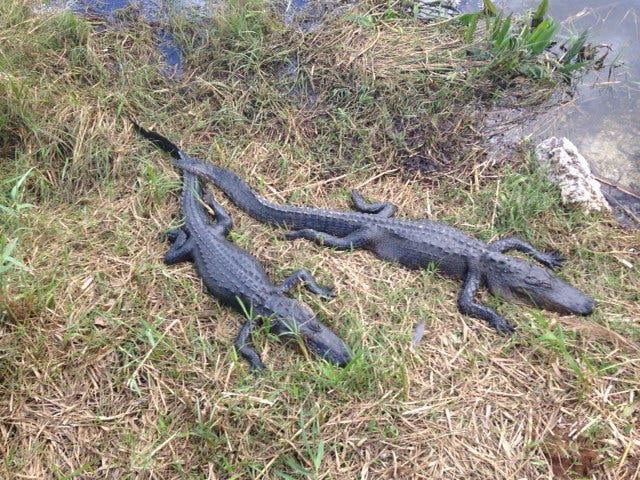
sleepng in the Everglades by DJB

Look at the ‘gators, just sleeping in the sun.  It’s difficult for me to speculate about an alligator’s thoughts, because their ability to think is pretty limited.  But anthropomorphically, they look as if they are just relaxing in the sun, affectionately intertwined.  Their hearts are pure their bellies are full.

These ‘gators, and about a dozen of their colleagues, are laying in a muddy patch near a path through the Everglades National Park.  This is different than the park where the commercial tours run; the ones that also feature a guy who wrestles with alligators. The same tourist attraction they have run since 1955.  Looking over at these lizards it’s pretty clear that they have no interest in wrestling with anyone. They are living out their alligator life, in their protected alligator swamp, seemingly unconcerned about anything more than when to get up and find their next meal.

Unfortunately, it isn’t that simple any more, not even for them.  Although I doubt those two realize it, they are lucky to be here. In 1955, due in part to people who captured them and put them in shows, but more because people made them into shoes and pocketbooks, and even more  because people drained  the swamps for farms and housing developments, alligators  almost became extinct.  But the government stepped in and protected them and persevered great swaths of their habitat. By 1987, they were no longer endangered.

But now, we may be seeing a government that doesn’t care as much about spending a lot of money to protect swamps and mud holes.  Also, the water that comes into the swamps and mud holes maybe coming in too quickly and getting too deep, and is changing the composition of what kinds of creatures can live there.  In addition the water now contains a lot of strange, man-made chemicals that are toxic to many of the creatures that live in those swamps.

But really, although I do like alligators, as well as great blue herons, ospreys, and piping plovers, and also the southern toads and pig frogs, and every other fish, animal, bird, plant and bug in the Everglades, I care more about my grandchildren, and the kind of world in which they will be living.  I know that if the Everglades, and many of the other estuaries that provide the basic nourishment for the bottom of the food chain become greatly diminished, then everyone’s ability to to grow and find food, all the way up to the top of the chain becomes diminished.

But, really, this isn’t really about climate change.  What these two sleeping reptiles don’t seem to be thinking about is how much the lives of all of us, every creature on earth, have become so much more intertwined over the last hundred years.  What happens in the Everglades affects the lives of people and polar bears in Alaska.  What happens in Washington and Beijing can be a matter of life and death in Syria and Brazil. The way you treat your neighbor affects how I treat mine.  It has become almost impossible to live a life in isolation.  Everyone is connected, whether you want to be or not.

I realize, having walked out on a starry night deep in the desert in Arizona, or up in the mountains of Idaho, that it can feel as if the rest of the world is far away and that I am alone, independent  and self-dependent. But as soon as I want to eat, find water, or to talk to another human being, I will be affected by, and have an affect on, the rest of the world.  Not just the town, the country or the state that I’m in; the world.

This is true because the people of the world are all now in constant communication with each other.   People in Afghanistan were watching the Super Bowl (great game, wasn’t it). People in India were watching Lady GaGa( I didn’t like those shoulder pads). China holds billions of dollars of America’s debt. On my table in Massachusetts is coffee from Africa or Central America, fruit from South America, on dishes made in Portugal. People in those countries are eating bread made from American wheat, and driving American tractors across their farms. Many people are dependent on life-saving drugs made in America, Switzerland, Germany, Israel or India.

People are moving all across the world, some running from terrible conditions, others going to seek better educations and opportunities.  They are inter-marrying, and often their children are moving to new places. This isn’t going to stop, even if one country decides to build a wall.

Ideas are flowing even more quickly across the world. Some people are trying to finding ways we can all benefit from each other’s knowledge, and improve the lives of everyone, all across the globe.  Others a still pretty primitive, and are spreading ideas about how some people are different and should be driven away, or blown up.

To those who say that if everyone would just take care of themselves, and not hurt anyone else, that’s enough, I have to answer, sadly, that is no longer true.  We now still have to take care of ourselves, but also be aware of how we do it, and how it affects everyone else.  You can’t leave your garbage in the woods.  You can’t burn your garbage in the back yard. You can’t leave the water running all day.  You can’t drive a car that doesn’t run clean. You can’t text while driving that car. Burning down the rain forrest in Brazil affects the air quality in Russia.  Insider trading undermines the trust necessary to financial transactions.  Discriminatory housing practices create tensions and anger that can ruin a city. Not paying taxes undermines the fairness of a society. Corruption and unfairness make doing business much more difficult.  Everyone who feels cheated starts to cheat to protect themselves.

The fact that the rest of the world didn’t care that the Israelis and Palestinians never settled their differences for eighty years has affected almost everyone in the world. It has created the chaos and conflict through-out the region that has now affected almost every country in the world.

If people can’t support their families in Mississippi or Wisconsin it affects me here in Massachusetts, even though my kids have good jobs and my wife and I have just stopped working after forty years.  It affects us if kids in Kansas go to terrible schools and won’t be able to understand the world in which they are living, even if my grandchildren do.  Those Kansas kids will struggle and get angry and who knows who they will blame.

I would love to be able to relax and read a good mystery without feeling that something is going terribly wrong and I need to help fix it.  I would love to just post pictures of my grandchildren playing with ducks, or only spend time telling you how amazing Isiah Thomas has been for the Celtics. — which he has been and I do spend time talking about it. 

To all of you who spend part of the day meditating and being mindful.  And to the others who are reading about how to be wildly successful by focusing on your goals, that’s great, and go for it.  But be aware, that you can’t achieve your goal on your own, and also it’s worthless if the world you are living in is falling apart. If you just take care of yourself you may not notice that the freedoms of other people to just take care of themselves is slipping away. They are not sliding down a slippery slope, they are falling off a cliff, and once they go we all soon will follow.


We all have to be aware of what we are doing and how it affects other people, even, and perhaps especially, the ones who don’t know, who we think of as different from us. We are all in this together.  We will all live together in a better world, or we will all live like the poor people of Somalia, with constant conflict and chaos.  Those are our choices. The choices are becoming clearer each day.

So, as they say at the check-out counter: “Have a great day.”

Friday, March 25, 2016

ReDesigning People -- 1


Hey, where have you been.  I've been working on some new stuff.  It's taken a while but now I'm pretty far along.  Maybe I'll keep posting stuff here.  But I've said that before.

Anyway, here's an

Introduction:

In the Spring of 2012 I was  sitting with Carrie, an attractive, articulate sixteen year-old young woman.  She had come to me because she was having panic attacks.  She said sometimes she thought her head was going to explode, and at times that she couldn’t breathe.  These attacks often came when she was studying for exams at school  Carrie spoke in a very animated fashion about how difficult it was for her to maintain her excellent grades and still keep up with the constant influx from her social connections.  As she spoke her voice cracked a little and her dark hair fell in front of her dark eyes that would fill, but not overflow with tears.  Her parents, Sandra and Carol, were sitting in my waiting room, while her friends, many of them, were wondering where she was and why she was not answering their text messages that were making her phone ping every thirty seconds.
I have been a psychotherapist for over forty years and have been closely involved in thousands of people’s lives, yet that was the moment it became undeniably obvious to me that I was living in a new world; a world that is not only creating changes in how we all live, it is creating changes in who we all are. Changes that will alter the basic make-up of our species,.
The changes are technological, environmental, scientific and societal.  The most powerful changes are the result of how all of those factors interact.  This new world requires  different skills in order to adapt and succeed.  Many of the ways of thinking and acting that were adaptive and helpful two or three generations ago, are no longer useful; others have become counter-productive.
Our grandparents and great grandparents lived in a world that was very different from the one that their great-grandparents lived in.  The early twentieth century was a time of change, especially compared to the early nineteenth century. It was a time of significant industrial and mechanical advances. The pace of that change has continued to increase so that now, in the early twenty-first century, we live with constant change.  We expect it to continue. But as we are changing the world, the world is changing us. 
Until the mid-Twentieth Century our species has been Designing People in basically the same way for a few millennia. There have always been three basic interacting forces that designed who we become.  First there is evolution. The genetic scripts of who we are pass from generation to generation, with occasional mutations, some of which survive. Second, the family grouping, whatever shape that has taken, exerts its influence.  The third powerful designer of our behavior is the community, the subculture in which we find ourselves as we emerge into the world.  Combined, these influences shape what we  believe, and how we think, feel and act.  It has been this way since our ancestors walked upright. 

To me, Carrie is the symbol of how these basic designing influences are changing.  Carrie was conceived in a petri dish.  An egg was taken from one of her mothers and fertilized with sperm from an anonymous man who was selected from a profile in a book.  Her parents were not allowed to be married at the time, but they were living together and as soon as the law was change d they got married. Carrie has a little brother now, and they all live in a happy, caring family.  The community in which Carrie lives accepts her family without question. These are circumstances that her grandparents would not have believed possible.
The visit with Carrie happened in 2012, and since then things have continued to change rapidly in our society. This is mainly due to new technologies, and to the new scientific knowledge that these technologies have helped us acquire.  The aspects of Carrie’s life that seemed unusual then are commonplace and well accepted now. In just the past few years there are even newer methods of creating children, more diverse blending of families, and different variations of societies that are all having a strong influence on everyone’s life. The expectations of how Carrie should behave, the skills she will need to learn, and how she will learn them, are also different.   All of these things are vastly different than what was expected of me, growing up in the middle of the twentieth century.  All of these things are not only changing how people behave, they are changing their bodies and minds.  They are ReDesigning People.
New information about who we are, what we want, how we behave, and how we communicate, comes pouring in in huge waves, every moment of the day. It affects us whether we realize it or not. Many people spend hours a day sitting in front of a screen gathering and dispensing information while things beep and pop up, pictures and videos appear and disappear, quickly replaced by others, with very little time for reflection.
We have devised new ways of mixing stands of DNA in a petri dish to create new people, and now newer, faster, more direct ways of splicing and reconnecting those genes in order to alter who that person will be.  
The evolution of machines  has progressed much faster than the evolution of people.  Many of the daily tasks that for centuries required manual labor are now done by machines, even the task of building those machines.  We also use machines to calculate, and then to find patterns, make predictions, and develop protocols about what we should eat, what medicines we should take, what we will buy, and who we will marry.  These machine generate algorithms which influence many of the decisions we make, mostly without our realizing that it is happening.
The climate we live in, including the air we breathe, the water we drink, the food we eat, the clothes we wear, all contain chemicals, viruses, bacteria, and proteins that have either been locked away in environments that never had contact with people until recently, or have been created in laboratories to either help us stay healthy or make us buy food that will make us fat.
These are changes that will affect the way Carrie lives her life, and they will have a more profound effect on her children. Her generation will also experience a continued growth in how medicine is developed, designed and delivered.  The hope is that people will be able to live longer and healthier lives. However, it may just be that as diseases are treated, other aspects of our lives fall apart. Will our brains last as long as our healthy bodies?  Will earth be covered with centenarians who need their diapers changed?  Will our air become too warm or too polluted for people to breathe easily?
Societies are changing also. To the horror of some and the delight of others, people from every part of the world are moving to every other part of the world. Marriages are occurring, babies are being born and cultures are mixing in ways that has never happened before.  Many of the old institutions that helped people define their values and guided them towards certain behaviors are being questioned or ignored.  This is a disrupting transition that is creating a great deal of conflict between those who feel the old ways are still the best, and those who feel that old traditions and rituals are antiquated and irrelevant.  While it is presently unclear how those arguments will be settled, it is clear that societies are changing dramatically, and people will think and believe differently than they do now.
The effect of all of these changes is that we are ReDesigning People, in part by design, in part due to unintended consequences.   As a psychotherapist I have spent years helping people to redesign their lives.  In many cases I felt successful, but in many others I felt there were too many factors  over which I had no control that were more powerful than anything I could do in my office. I could do little about the person’s genetic make-up, their economic resources, the extent to which they were subjected to racial prejudice or the toxic environments had shaped their lives. 
In many ways Carrie is a very fortunate young woman.  From her background we can assume that her genetic structure is close to flawless.  The egg and the sperm that were used to create her were specifically selected because they came from people who were strong, healthy, smart and attractive.  While she was in utero her DNA was tested and screened for many possible genetic defects. She is being raised by a happy couple, who have financial resources, in an accepting neighborhood with a good school system and a diverse population. Given all of this her prospects for a good life are high.
Sadly, she is suffering for the overarching malady of this new world, anxiety.  Anxiety often is the result of having feelings of little or no control of what will happen.  The feeling of living with constant change, and the uncertainty of what that change will produce has instilled a feeling of anxiety into almost everyone who has electricity, a computer, a cell phone and wi-fi.  There is too much information, too much traffic, too many demands, too little time, and not enough stability.  It is impossible to name any company, any city, any government , any medicine or any institution that won’t be radically different in fifty years.
This creates anxiety.  Anxiety creates stress on our bodies, brains and minds.  It changes our functioning down at the cellular level.  All of these forces, some of them very favorable, but many of them very unpredictable, are changing the nature of who we are.  We are ReDesigning People.


In this series of essay I will describe this process and some of its possible consequences in greater detail.  I certainly welcome any comments.

Wednesday, February 17, 2016

Miami

While I have a minute here, let me tell you some thoughts about Miami.
We drove out of the cold, even though it wasn't so cold this year, and all along the Eastern Sea Coast of the USA, down to the city of Miami.  We stayed there for three weeks.  We rented a condo on the 23rd floor of one of the many towers that line Biscayne Bay. We were on the city side.

Out place was not on Miami Beach.  We went to that side of the Bay a couple of times, but mostly that neighborhood is full of high priced hotels on the water, and lower priced, art deco renovations a few blocks from the beach.  They look great, and many of the renovations are very well done, but the place is a frat party. Now if I were single and forty years younger, opps, make that fifty years younger, I might have a good time on Miami Beach from 10 PM to 5 AM.  Seems like a lot of things can happen that could be fun for a brief time, and lead to heart-ache and hangovers later, and stories to tell for years after that.

But we are not in that market.  We went to Miami beach twice.  Once with my son and his family, including kids 2 and 4 years old, and once to swim in the ocean. We went in the morning when there was plenty of parking and the only folks around were either cleaning up from the night before, or asleep on lounges on the beach.

However, the city of Miami is the future.  The city is thriving. The building that is going on is amazing. The towers that were built on the bay fifteen years ago, rose to forty stories tall.  The ones built five years ago, next to or behind the first ones are sixty stories tall.  The ones they are building now are going to be eighty stories tall.  They are steel and glass with balconies.

I don't live there.  I go to visit, be warm and have some fun, so I don't spend much time thinking about where all the money for these places comes from.  Obviously, a lot of it is from South America. Money is safer in Miami  Who knows what can change quickly in Peru, Colombia, Bolivia or Venezuela, as well as Brazil and Argentina.  So people put their money in high rise condos in Miami.  They bank in Miami, they put their mistresses, the ones you see with the augmented breasts, walking their little dogs, into those buildings.

I have been told there is lots of money coming in from China too, and probably lots is smuggled out by some of the Russian oligarchs, and sheiks from the oil countries.  Not my problem.

But being in Miami is seeing the people of the future.  They come from everywhere, and they live, work and play together.  The first language of the city is Spanish.  There is Puerto Rican Spanish , as well as Mexican, Cuban, Haitian, and dialects from all over South and Central America. There is a lot of Brazilian Portuguese.  There is Moroccan and Canadian French.  Almost everyone speaks English, and there is still a tiny bit of Yiddish left, but that is almost gone.  Moved up to Boca. People switch languages in the middle of their sentences, using whatever word fits best.

The people range in color from whitish, to very Black, but most are some shade in-between.  The money seems to be distributed almost evenly among all of the colors, but not the neighborhoods.  Along the water there is money.  There are Maserati, Lamborghini, Bentley, and Ferrari, zipping along those streets.  Five blocks to the west, there is very little money.  There are lots of twenty year old Honda Civics driving slowly through the streets.

So many different  restaurants.  So many kinds of foods at all kinds of prices.  Our favorite serves food that is a Haitian/Asian fusion. So many different kids of music, all over the place. And while there are still many that play the music of the old culture, most of the newer stuff is a blend of three f or four cultures; Spanish,/hip-hop,/rock.  Jazz/Cuban/soul/Beethoven

It's all coming together down here and the rest of the country will follow.  It will make America a wonderful place to live, an whoever gets on the Supreme Court won't be able to stop it.

And soon all the buildings in Miami will be connected by beautifully colorful skywalks, as the first four or five stories will all be under water.

But as long as the kitchen is dry, things will be fine.

Friday, May 29, 2015

We were relaxing on the deck, talking to some friends this weekend, now that it's Summer.  We don't get Spring any more; it goes from sixteen feet of snow to 87 degrees in a week. But all this climate change stuff is just a Liberal plot to ruin business and make coal and oil companies look bad.

Relating to that, one of my friends has just returned from one of his many trips to China where he, like many American businesses, has employees.  He told me that he has a factory in a city I had never heard of that has nine million people.  I looked it up and saw that there are about twenty cities in China with more than five million people. Half of those have over ten million. By contrast, the U.S. has one city with a population of over five million,NYC. One.

I have worked as a mental health professional in a city that has a population of 110,000. There are lots of mental health problems to be dealt with. So, I wondered, what goes on on China?  What do those people think about?  What is it like to be in a swarming city of new high rise apartments that go on and on.

I have never been to China. I think I'd like to go, but I don't think I would really get to answer my questions since I don't know the language and I probably wouldn't get to do interviews with any of the people who live in those high rise apartments.

But I'm sure that their outlook on life, and the things that run through their brains and minds are in many ways very different, and in other ways very similar to mine.

I imagine they worry about their families and hope for the best for their children.
Do they worry about climate change?
I'm sure they have personal relationships, and relationship problems.
Would they talk to a therapist?  Is that something that is done?
Do they relate to a tight little community that surronds them, or are left feeling overwhelmed by having millions of people close by.

Culture, and subculture has so much to do with how our brains are programed and how we view ourselves and how we fit into the world.  We are all human, and that gives us some basics, but it can be molded and shaped so differently.

So many of the differences are clearly learned and shaped by culture. We know several Chinese-American families that are very American, but still have Chinese customs.  We know several Chinese born women who were adopted by American families as infants, and they are totally American.

The world shrinks, but it doesn't
People get to know each other, but they don't

This will continue to change.  I believe that we will all become more homogenized over time.
But not in the same ways.  Sadly, I am beginning to believe that the rich all over the world will become more like each other.  The poor all over the world will have similar difficult lives.  Those two groups will be very different.

I hope that the future proves me wrong.

Sunday, February 22, 2015

Connect the dots: piles of snow and the ISIS killings.


            Today the sun came out for a few hours and the temperature rose to thirty-six degrees.  The snow around my house began to melt for the first time in weeks.  The seven-foot high piles are now only five feet high, the twenty-foot piles seem about the same.  The dripping off the icicles of mass destruction was constant.  Of course, now that the sun is setting, and the temperature is dropped, everything with freeze solid.

            As anyone who has paid any attention to any media knows, this has been an historic winter here in New England.  And it shows no sign of getting easier.  It will be very cold tomorrow, and more snow will come on Wednesday.
            Last winter did not have as much snow, but the cold came very early, before Thanksgiving and it stayed very cold until the middle of March.  This year seemed as if it was going to be an easy winter until the middle of January, but then everything changed.
            During this time there has been a group of religious zealots who say they are trying to bring about the end of the world.  Their stated goal is to incite a holy war between Muslim extremists, and the rest of the world, a war that will result in total destruction.  This kind of disruptive, oppositional thinking has attracted a following of people who seem to be either fed-up or frightened about things that are happening in the world today, including globalization, exploitation, multiculturalism, allowing women to think and mostly, worshiping the wrong God.
            For a while these were just two different things that upset me, and then I read the article in the February issue of Scientific American by Michael E. Webber that explains the interactive dependence of the availability of water, food and energy.  He shows clearly how the abundance of one of those can help create an abundance of all of them, and how a scarcity of any one of them can lead to the scarcity of the others.
            I also remember reading a few years ago (sorry, but I can’t cite the source right now) about how climate change has lead to the drought in Sudan and how that was large contributing factor in the civil war that broke out in that country.  It is also true that there has been a drought for the last few years in Syria, and that drought lead, as Dr. Webber ‘s thinking would predict, to a rise in food prices, which was a large part of why, after many years of being able to tolerate a repressive government in Syria, there was a revolt among the hungry and dissatisfied people. 
            That civil war has been going on for three years now, and has ruined the country.  Hundreds of thousands of people have died, and millions have been injured, displaced and traumatized.  That kind of chaos and instability easily spread to the neighboring counties that were already full of conflict and turmoil, and that allowed ISIS to rise and attract followers.
I believe that it is the same forces that has changed the climate and lead to a drought in Sudan and Syria that has lead to the long period of cold and heavy snows here in New England. There will not be a drought in New England this year; we will have too much water for a while, including some flooding.  But the states in the Western part of the U.S. are still in a continuing drought and there will be many struggles for water; water for crops, water for drinking, water for the fountains at the hotels in Las Vegas.
            This will lead to uncertainty, discontentment and anger.  I don’t think it will lead to a revolution.  But people will blame the government, the immigrants, and the corporations.

            How many people will realize that the world is now linked and interdependent in many complex ways?  Probably more than just me.
            But how many people are ready to make the significant changes?  Probably more than before, and hopefully enough to make a difference, but that remains to be seen. 
            When there is scarcity there is fear, and when there is fear most people worry most about themselves and their own families.  It’s hard to put it all in context when your livelihood is threatened.

Wednesday, September 25, 2013

The short answer

"A Mister Richard Fader from Fort Lee New Jersey writes:".......(most of you probably get that, right?)

Anyway, more than one of the questions I received was from far away and it asked, simply, if I thought that there would ever be a time when the people of the world would get along better, and that greedy, power-hungry people would no longer have such a strong influence.

I replied:
I do think that, overall, the world has become more civilized and there is really less torture, fewer huge wars,     and more are  people getting along better. I don't know if you have a chance to read Steven Pinker's 
"Angles of Our Better Nature" but he makes a good case for that.


Yet, it is obvious we are not close to the great wave of human harmony.  I think the global climate change has 
put pressures on countries to fight for basic resources that are becoming more scarce.  
That is a lot of what underlies the problems in the Middle East and northern Africa today. 

I also think that technology has made life so much more efficient that it is becoming more difficult 
for people to find meaningful work, if they can find work at all.

Until those problems are solved in a manner that gives everyone a chance to survive and have a 
decent, but not decadent lifestyle, there will be fighting and trouble.

Take good care of yourself.


Saturday, June 22, 2013

Gettysburg to 2013 to 2163

We are rapidly approaching the 150th anniversary of the Battle of Gettysburg, one of the bloodiest few days in U.S, history.  This will be a time of reenactments, strategic studies, and speeches about valour, honor, freedom defended and freedom lost.

There were fifty thousand casualties at Gettysburg.  Most of them were young men who had holes shot through them from fairly close range.  Most of them probably had little idea of exactly what the reason was for them to put their lives in danger.  They were defending their land and their culture.  They were brave, irrational and sucked in by peer pressure or fear of punishment for treason.

The underlying cause of that battle, and of the entire U.S. Civil War, had to do with the existence of slavery. Looking back on that, from a perspective of 150 years, there are few few people left, not even Paula Dean, who will defend the enslavement of other humans.  It seems very generally accepted that it is inhumane, unjust, and that it should not be done.

But that does not mean that soldiers from the South, the slave owners, and all of the others who went to war, were callous, mean or inhuman.  In truth that war, like many that have followed it, was due to changes in economic and energy policies.  The Southern states depended upon slavery to keep it's economy profitable. If they had to pay people to built those beautiful houses in Charleston most of them would not have been built.  If they had to pay a decent wage to plant and harvest cotton, the price would have been too high for the North, as well as the English and French to want to pay for it.

When almost any society is threatened with a complete loss of their comfortable lifestyle the most common reaction has been to go to war to save it.  That's a good part of what caused the American Civil War.

Now, 150 years latter, there is another debate occurring about the U.S. energy policy.  There is no threat of war because, at this time, there is no threat that anything is going to change that policy.  There is a major threat ( it is already occurring) that if that policy does not change that we are radically altering the living conditions of the planet we live on.  There is a large possibility that the number of casualties will be greater than the 800,000 of the Civil War.  Due to the violent weather we have had just in the last five years, millions of people have been affected.  Many have lost their homes, most of their possessions and their livelihood.  Many across America have been injured and many have died in floods, tornadoes, hurricanes and fires or have been affected by some of the worst droughts in history.

Many across the world have been affected by floods and droughts that have ruined economies and resulted in starvation, refugees and wars.

In 150 years, in 2163, when people look back at what is happening today, I think that the lack of action on the energy policy that affects climate change will seem as unacceptable as slavery seems today. But people are defending it now for the same reasons they did then -- there are many people making a good living the way things are.  Oil companies, car companies, electric companies, any company that uses a lot of power to do business does not want to pay for the changes that would be necessary if we began to eliminate fossil fuel.  Most of us wouldn' t even be able to get to work.

It's very possible that some kind of new technology will save us from these catastrophes, but if that happens it won't be cheap.

But in 150 years, if many cities are under water, or billions of dollars are spend to prevent that from happening, if the weather patterns are consistently more violent than today and huge rains, long droughts and tornadoes become common, people then may be wondering that we were thinking.

We were thinking the same thing that the soldiers in Pickett's Charge were thinking: we are defending our way of life.